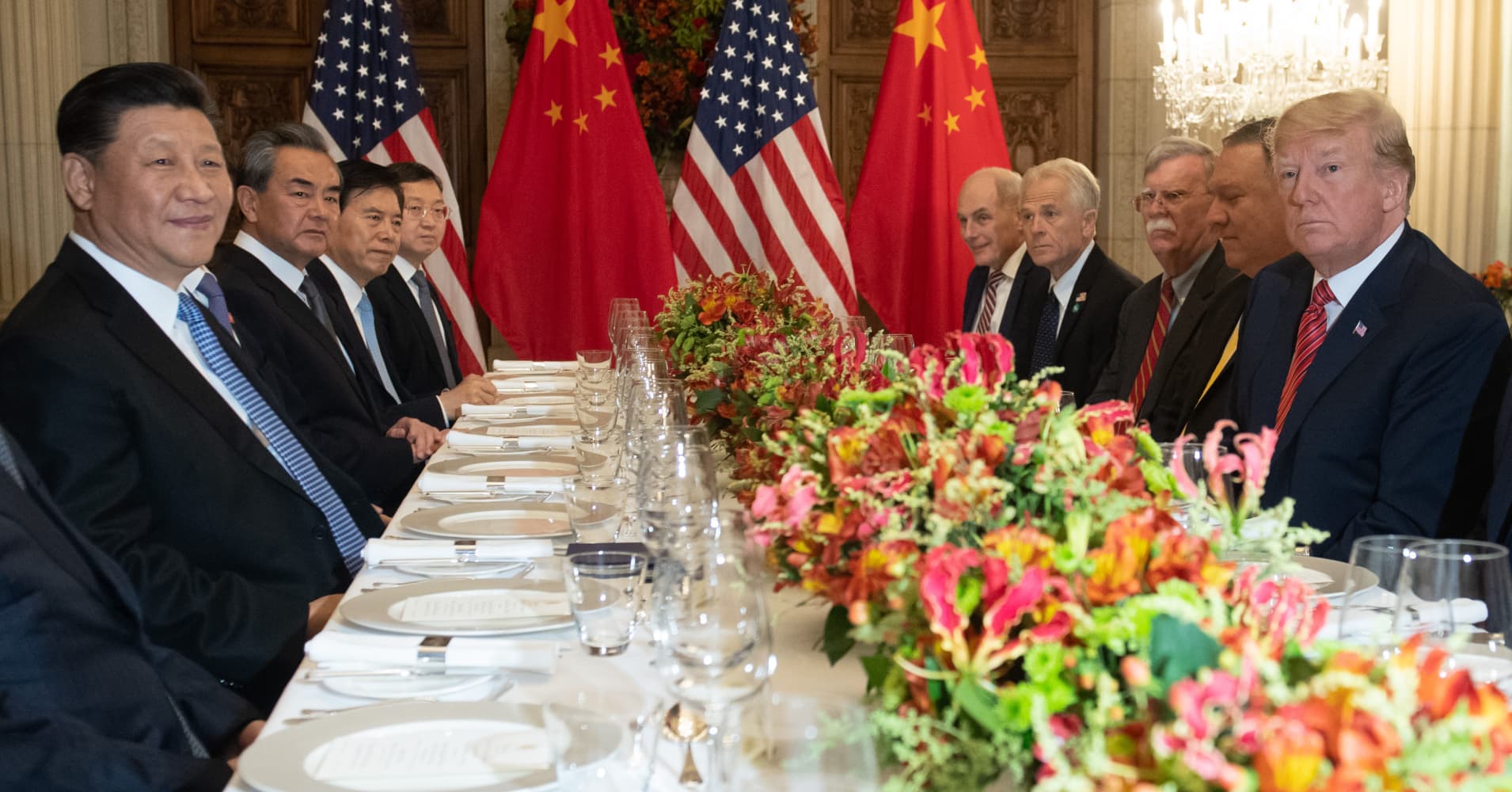
As President Donald Trump says his administration is moving closer to a trade deal with China, one of the major sticking points has been China's disregard of intellectual property protections and claims dating back years about rampant Chinese theft of corporate trade secrets. The allegations are not hyperbole.
One in five North American-based corporations on the CNBC Global CFO Council says Chinese companies have stolen their intellectual property within the last year. In all, 7 of the 23 companies surveyed say that Chinese firms have stolen from them over the past decade.
As the Trump administration works on a trade deal with China and hundreds of billions in potential tariffs loom if a deal can't be reached — Trump has delayed the tariffs scheduled for Mar. 1 based on "significant progress" he said is being made — the issue of IP theft has been a huge sticking point.
The CNBC Global CFO Council represents some of the largest public and private companies in the world, collectively managing nearly $5 trillion in market value across a wide variety of sectors. The survey was conducted between Feb. 7 and Feb. 22 among 54 members of the council located across the globe, including the subset of North America-based chief financial officers.
Hardline Trump U.S. Trade Representative Robert Lighthizer said on Wednesday in testimony on Capitol Hill that a deal with China must not only include more Chinese purchases of U.S. products but enforcement. There have been recent reports that Lighthizer is unhappy with Trump's willingness to make a deal with the Chinese without extracting strong enough terms. White House officials have downplayed the reported tensions.
"We can compete with anyone in the world, but we must have rule, enforced rules, that make sure market outcomes and not state capitalism and technology theft determine winners," Lighthizer said in testimony to the House Ways and Means Committee on Wednesday.
"Let me be clear," Lighthizer testified. "Much still needs to be done both before an agreement is reached and, more importantly, after it is reached, if one is reached."
After the December G20 meeting in Buenos Aires, Argentina, China took a step that conservative think tank American Enterprise Institute — which for years has been sounding alarms about IP theft by China — described as significant, when the Chinese government issued a memo that set out some 38 punishments for IP violators, including denial of access to government funding.
"The mere publication of the memo (which explicitly referred to American complaints) was an important concession: Until quite recently the Chinese government had officially denied that significant IP theft occurred in China," AEI's Claude Barfield wrote in a blog post. But the issues are complicated by, among other things, blurred lines between cyber espionage committed by the Chinese government against corporate and military targets and the passing on of those secrets to Chinese companies.
There are no exact statistics on trade secret theft ranked by nation, but China remains the world's principal IP infringer across all types of IP theft, according to a spokesman for the IP Commission, and he noted that Chinese citizens are prosecuted most frequently in U.S. courts for trade secret theft.
Cases of IP theft in recent years brought by the U.S. government against Chinese employees of U.S. firms and Chinese intelligence officers have involved large companies including Apple, IBM and GE.
North American-based companies are less concerned that they have been in recent quarters about the impact of U.S. trade policy on their business. Only 17 percent said uncertainty surrounding trade policy would hurt their companies ability to make long-term investments. Eighty-three percent indicated that tax reform and eased regulations outweigh any ongoing trade issues. CFOs across the globe also remain confident that the U.S. economy will not face a recession in 2019 — not a single North America-based CFO taking the survey thinks there is a risk of recession this year.
But in Europe, where trade tensions between the U.S. and EU countries have been rising, the risks from U.S. trade policy are becoming more prominent. U.S. trade policy was the No. 1 external risk factor cited by CFOs from the Europe, Middle East and Africa region taking the survey, with 35 percent saying it was the biggest current threat to their business. That was higher than the percentage of CFOs from the Asia-Pacific region citing trade policy as the biggest external risk (29 percent). Only 17 percent of North America-based CFOs cited trade policy — concern about consumer demand was cited by many more CFOs from the U.S. (43 percent).
Across the total of 54 CFOs included in the Q1 CNBC Global CFO Council survey, consumer demand was cited as the No. 1 external risk factor (28 percent). Meanwhile, U.S. trade policy fell from No. 1 in the fourth quarter of 2018 to No. 2, with 26 percent of global CFOs citing it as the biggest external risk.
U.S. trade policy remains far from a positive contributor to business outlook even as it slipped from the top spot among risk factors. CFOs across the globe overwhelmingly say its impact will be negative over the next six months, but the severity of that view declined from the fourth quarter of 2018 (when 73 percent of CFOs said it would be negative) to the Q1 survey (63 percent).
Full results from the Q1 CNBC Global CFO Council survey are below:
(Note: The CNBC Global CFO Council Survey for the fourth quarter was conducted from Feb. 7–Feb. 22, 2019. 54 of the 124 global members responded to the survey (23 North America, 17 EMEA, and 14 APAC).
Let's block ads! (Why?)
from Top News & Analysis https://ift.tt/2VvvI9z
via
IFTTT

