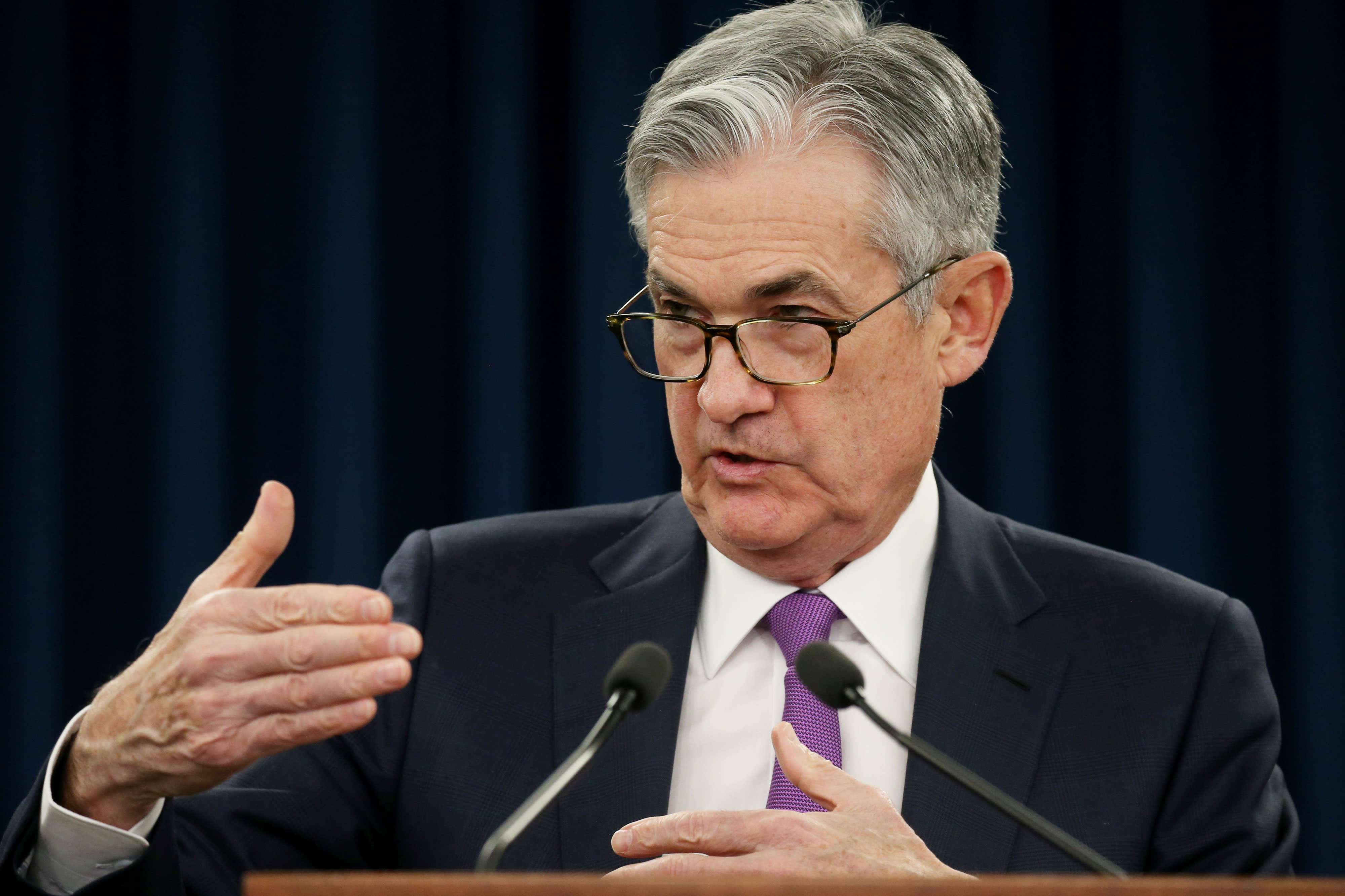
Federal Reserve Chairman Jerome Powell holds a press conference following a two day Federal Open Market Committee policy meeting in Washington, U.S., January 30, 2019.
Leah Millis | Reuters
While Federal Reserve officials insist they are comfortable with the current state of policy, Wall Street still thinks the burgeoning trade war between the U.S. and China will change that picture.
Much of the market chatter has been focused on the likelihood of an "insurance" rate cut this year — a move that would provide a buffer against any economic weakness that the tariffs could cause. Economists worry that a prolonged impasse would sap consumer and business confidence and halt what has otherwise been the strongest growth of a recovery that began a decade ago.
"A meaningful slowdown in U.S. domestic demand from the trade dispute may lead to rate cuts," Beth Ann Bovino, chief U.S. economist at S&P Global Ratings, said in a note for clients. "The Federal Reserve is in wait-and-see mode, but the chance of an 'insurance' rate cut has increased."
Public statements from Fed Chairman Jerome Powell and almost all other central bank officials point to no rate increases or cuts this year. Still, the futures market is assigning a 69% chance of a quarter-point reduction by the end of the year.
The mixed signals come amid an intensification in the trade war that has seen the U.S. increase tariffs to 25% against $200 billion in Chinese goods while threatening to put levies on another $300 billion of imports. China has retaliated with its own intention to slap tariffs against $60 billion of U.S. goods.
Tariffs are generally considered inflationary as they raise the cost of goods, and major companies including Walmart and Macy's have warned that prices likely will go up.
However, Bovino said the Fed likely will consider modest price increases to be transitory until the two sides can reach an agreement, and thus would be unlikely to make policy changes. In fact, she said the longer-run impacts would be more likely to depress consumer and business activity and thus would generate looser Fed policy.
"While the trade war brewing between the U.S. and China will likely have minimal direct macroeconomic effects on either country in the near future, the longer-term consequences for global supply chains, U.S. business sentiment, and consumers' purchasing power are growing," she said.
Gross domestic product rose 3.2% in the first quarter, well above expectations. Economists expect that activity slowed considerably sine then, with second-quarter GDP growth projected to come in at just 1.2%.
via IFTTT

No comments:
Post a Comment